DEAR LOBOS

DEAR LOBOS

spring flowers with a campus building in the background

DEAR LOBOS

Photo of President Garnett S. Stokes

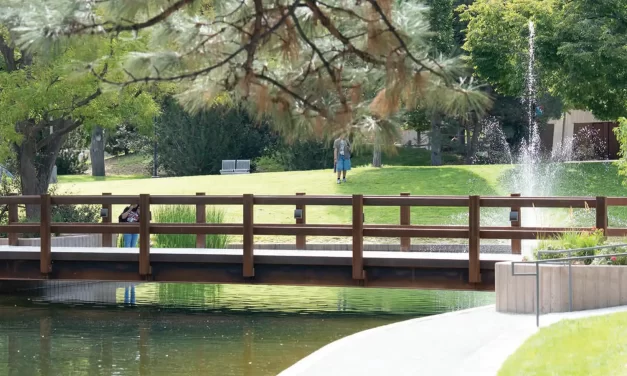
Spring has arrived in Albuquerque, and with it comes that unmistakable sense of renewal and momentum on the campus of The University of New Mexico. From the fresh blossoms surrounding our newly renovated Duck Pond—you can read more about it in these pages—to the energy of Lobo Day celebrations, this season reminds us of the enduring spirit of our community and the pride we share in being Lobos.
As always, Mirage captures that spirit perfectly. We were honored this spring to welcome Mark Woodbury to campus for a Lobo Living Room conversation that challenged our students to think creatively about leadership, innovation, and the future of immersive storytelling. You’ll also read about the remarkable work of Noé Barnett, whose Route 66–inspired art celebrates the centennial of an iconic American highway—and our relationship to it as Lobos—while reflecting the creative energy fostered at UNM’s “ArtsLab.”

We’re also proud to mark the 50th anniversary of the Presidential Scholarship, a life-changing opportunity made possible through the generosity of the UNM Foundation and alumni like you. This milestone is a powerful reminder that when Lobos invest in one another, we create opportunity that lasts for generations. And as our alumni community continues to grow, I know you’ll enjoy learning more about your latest UNM Alumni Association president, Aprilyn Chavez-Geissler, whose leadership and dedication are strengthening the bonds that connect Lobos everywhere.

As I write to you this spring, I also do so with a full heart, as this will be my final semester serving as president of The University of New Mexico. I am incredibly proud of all that has been accomplished since I arrived here in 2018, whether it’s putting in place our Grand Challenges to define some of our most critical research priorities; making new investments in athletics; working to expand the number of health care providers for our state; advancing our university as a global leader in quantum technology; or helping to guide the implementation of UNM 2040, our long-term strategy for the future of The University of New Mexico. While these things happened during my presidency, none of them happened alone.

I have been fortunate to work alongside an extraordinary leadership team that guides this university with vision and integrity. Our faculty shape our identity through their knowledge, research, and mentorship. Our staff bring the energy and commitment that keep our institution moving forward every day. Our Lobo health care professionals provide compassionate care that touches lives across New Mexico. And our students—remarkable, determined, and inspiring—are the heart of it all, carrying forward the Lobo legacy as alumni who make a difference in their communities and beyond.

Serving as your president has been the greatest honor of my career. While it’s been the toughest job I’ve ever had, it’s also been the most joyful, because we’ve done this work together. I am grateful for your steadfast support, your pride in UNM, and your belief in what this university represents, and I will always be proud to be part of the Lobo family. Thank you for making me a part of such an extraordinary pack.

With appreciation and warmest wishes,

President's signature
Garnett S. Stokes
President,
The University of New Mexico

Letters

Latest

Spring 2026 Mirage Magazine Features

Loading

New Faces

New Faces

Photos of Jennifer Malat and Bronco Mendenhall

New Faces

The College of Arts & Sciences, UNM’s largest academic unit, has a new dean in Jennifer Malat, who comes to UNM from Virginia Commonwealth University, where she was dean of the College of Humanities and Sciences and most recently associate Vice President of Development. Before VCU, she was the inaugural Divisional Dean for the Social Sciences in the College of Arts and Sciences at the University of Cincinnati.

Malat said she was drawn to UNM because of its status as a Hispanic-Serving Institution with a strong commitment to its public service mission. During her time as dean of the College of Humanities and Sciences at VCU, Malat shepherded the College through the first two years of the pandemic while also prioritizing improved equity for faculty, students and staff.

Alina Chircu will join the Anderson School of Management as dean this month. She comes to UNM from Bentley University, in Waltham, Mass., where she was a professor in the Computer Information Systems department and served as interim dean of Business in 2022 and associate dean of Business for Graduate Programs in 2019 and 2020.

Chircu’s teaching and research interests include business process and value chain management, design thinking, digital transformation, and the business value, design, adoption and implementation of transformational business technologies.

UNM Provost James Holloway also appointed three interim deans — Leslie Donovan at the Honors College, David Weiss at University College and Maria Lane at Graduate Studies.

Bronco Mendenhall, a 17-year veteran head coach who turned around struggling programs at Brigham Young University and the University of Virginia, has been named the 33rd head football coach at The University of New Mexico. Mendenhall served as defensive coordinator and associate head coach for the Lobos under Rocky Long for five seasons from 1998 to 2002.

Mendenhall, 57, replaces Danny Gonzales, who was fired at the end of the 2023 season after an 11-32 record over four seasons with the Lobos.

Mendenhall served as the head coach at former Mountain West rival BYU for 11 years and at Virginia for six. He compiled a 135-81 record over 17 seasons at BYU and Virginia before he stepped away from coaching after the 2021 season. All 11 of Mendenhall’s BYU teams went to a bowl and he guided Virginia to three bowl games, including the Orange Bowl in 2019. His teams were 7-7 in bowl games. Mendenhall came to Albuquerque in 1997 to serve as Long’s first defensive coordinator. UNM’s defense, led by safety Brian Urlacher, excelled under Mendenhall. During his time at UNM, the Lobos improved from just three wins in 1998 to seven wins and an invitation to the Las Vegas Bowl in 2002. In the Lobos’ 27-13 loss against UCLA in the Las Vegas Bowl, the Mendenhall-led defense held the Bruins to a season-low 167 yards.

Spring 2024 Mirage Magazine Features

Loading

Understanding Headwaters

Understanding Headwaters

Photo of a waterfall

Understanding Headwaters

A $2.5 million grant from the U.S. Department of Energy is helping UNM researchers concentrate on the hydrological health of headwater streams, the small but complex rivulets that knit together to feed rivers. “Headwater stream networks are vital to downstream ecosystems,” said Alex Webster, a UNM assistant professor and principal investigator on the project, which is based in UNM’s Center for the Advancement of Spatial Informatics Research and Education.

The group is concentrating on five very different headwater stream networks spread across the continental U.S. — the Upper Santa Fe River Watershed in New Mexico, which drains into the Santa Fe River; the Dog Creek Watershed in Nevada, which drains into the Truckee River; South Sandy Creek in Alabama, which drains into the Black Warrior River; Richland Creek in Arkansas, which drains into the White River Basin; and the Lamprey River in New Hampshire, which drains into the Great Bay Estuary.

“Historically, we treated these headwater watersheds like black boxes. We tend to care about how much water comes out of them and the quality of that water, but not so much about the reasons why,” Webster said. “There is a lot going on in them. They are changing very quickly because they are very sensitive to climate change, including to changes in snowpack, and because that’s where streams tend to dry up first.”

The first stage of the project, involving a group of researchers at The University of Oklahoma, will include hydrologic modeling to predict what entire watershed stream networks are doing based on observations of waterflow, precipitation and other factors. The second stage includes understanding the spatial structure of each watershed in terms of how it influences water quality and quantity. The third and final part of the project will look at how all this changes throughout time in response to changing patterns of precipitation and drought.

“As the stream network dries up, we get less water downstream, but the important question is, if something happens in one part of the watershed, is that going to have a bigger impact compared to if it happened in other parts of the watershed? That sort of understanding will be incredibly helpful for water management,” Webster said.

The group of researchers will also work in collaboration with Oak Ridge National Laboratory to compare and contrast watershed findings to one being studied in Tennessee. Researchers say this study will impact future research and will provide essential infrastructure investment that will enable states to better monitor and manage the water quality and quantity that headwater streams export to downstream waters.

Campus Connections

Latest
Sorry, No Posts Found

Spring 2024 Mirage Magazine Features

Loading

No Je or No Sé?

No Je or No Sé?

Black and white photo of woman cooking on old stove with young boy sitting in a chair looking at the person taking the photo

No Je or No Sé?

In his research, Associate Professor Damián Vergara Wilson, the coordinator of the Spanish as a Heritage Language Program at The University of New Mexico, uses the term Traditional New Mexican Spanish to describe the unique Spanish language vernacular that has been nurtured in the enclaves of northern New Mexico and southern Colorado for generations.

Spaniards first arrived in the 1500s in what we know today as the state of New Mexico, bringing with them a now-antiquated form of the Spanish language.

The language picked up influences from Indigenous populations — particularly the Nahuatl speakers — and the language spoken in rural mountain villages of northern New Mexico and southern Colorado grew into a unique dialect. It has survived for hundreds of years, but has begun to fade from use as elders die and young people rely on English or the more modern Spanish taught in schools.

When New Mexico became a state in 1912, pressure to Americanize became greater. “Many educators and speakers of the prestige varieties viewed New Mexico Spanish as archaic, rural, full of errors and in need of remediation, and attempted to eradicate elements of the dialect in an attempt to teach us how to speak correctly,” Wilson says. “People still think they are doing their children favors by not teaching them Spanish, both immigrant populations and ones with long histories in the U.S.”

Examples of the old versus the modern include No je instead of No sé for “I don’t know;” muncho instead of mucho for “lots” or “much;” and dende instead of desde for “since.”

“The Spanish language, like any language, constantly evolves. There is a myth that we speak the Spanish of golden age Spain from the 1600s. While we do retain some words that are lost in other varieties, the language we speak is not an exact replica of that remote time,” Wilson noted.

Some scholars estimate the traditional dialect will disappear within 50 years.

“Shift is going to happen,” Wilson said. “Older speakers do not fully transmit a dialect or language to younger speakers when that dialect becomes viewed as lacking in value or when it becomes a symbol that challenges prevailing ideologies.”

Wilson, who was raised with the vernacular in Ojo Caliente, is among those trying to promote this linguistic legacy in his research and the classroom. In his Spanish as a Heritage Language program, Wilson is teaching a new generation of scholars to appreciate the traditional community language and attempt to preserve it. Students develop an appreciation of their heritage language. They learn about cultural connections, sharing experiences, background and linguistic knowledge with one another.

Campus Connections

Latest
Sorry, No Posts Found

Spring 2024 Mirage Magazine Features

Sorry, No Posts Found

‘A New Pair of Eyeglasses’

‘A New Pair of Eyeglasses’

Aerial photo of interstate exchange

‘A New Pair of Eyeglasses’

Nancy López, UNM Sociology professor and director and co-founder of the Institute for the Study of Race & Social Justice, has been awarded a $1.5 million National Science Foundation grant to create a resource to advance equity and student success in Science, Technology, Engineering and Mathematics (STEM).

“One of the organizing principles of intersectionality is that we can’t understand complex inequality if we focus on only one dimension of inequality,” López said. “It’s about having a new vision. When we examine inequalities in terms of race alone or ethnicity alone or gender alone, or whether you’re the first in your family to earn a four-year college degree alone, we may miss opportunities to remove barriers that may not even be visible. To our knowledge, not a single institution of higher education in the U.S. employs intersectionality for analyzing and reporting baseline equity metrics, such as admissions, enrollment, retention, degree attainment or postsecondary outcomes.”

López and colleagues will create a hub for conversations about the relevance of intersectionality for system-level change for student success. Faculty fellows, presenters, Hispanic-Serving Institution researchers and academic leaders will be involved and the hub will hold monthly virtual drop-in hours for anyone interested in learning about intersectionality policy and practice.

“How could we use intersectionality as a new pair of eyeglasses to understand complex configurations of inequality? With this grant we have an opportunity to lead the nation in having a better understanding of what we are serving and how we are advancing equitable success. One thing is clear: removing barriers to student success requires illuminating intersectional inequities as a first step for advancing transformational equity,” López said.

“The idea is that without intersectional inquiry and praxis we don’t know who we are serving and impacting. It is our hope that through sharing that insight, we can achieve a more robust understanding of barriers and possibilities for strategic action for advancing student success.”

The goal is to eventually have a concrete plan on how to advance equity in STEM education for all underserved student populations, and build successes once they move forward in it.

Campus Connections

Latest
Sorry, No Posts Found

Spring 2024 Mirage Magazine Features

Sorry, No Posts Found

Pin It on Pinterest