
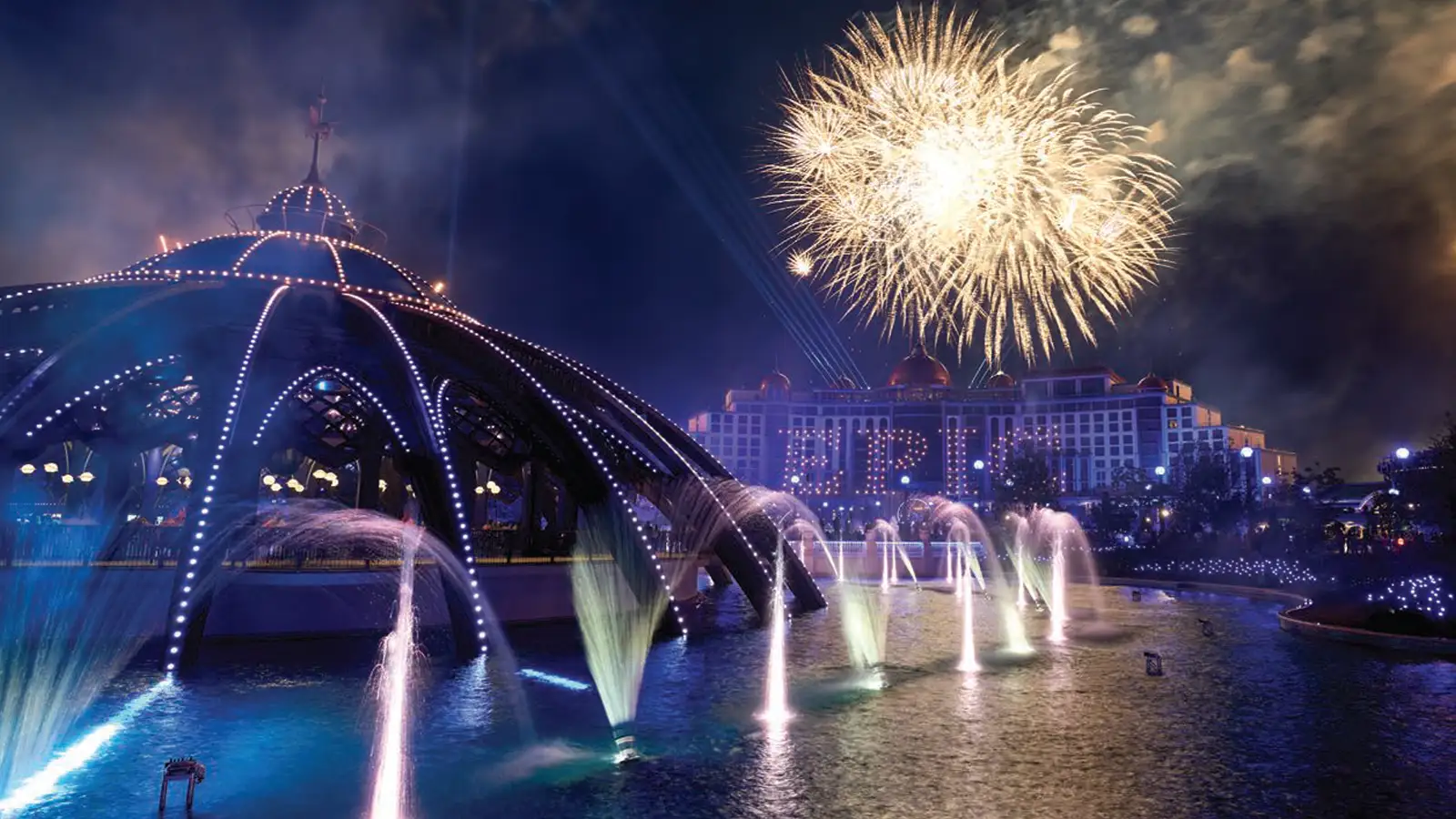
Universal Epic Universe, which opened in May 2025, is Universal’s most ambitious project yet and marked the first major theme park built in the U.S. in 25 years. Photo courtesy of Universal Destinations & Experiences.
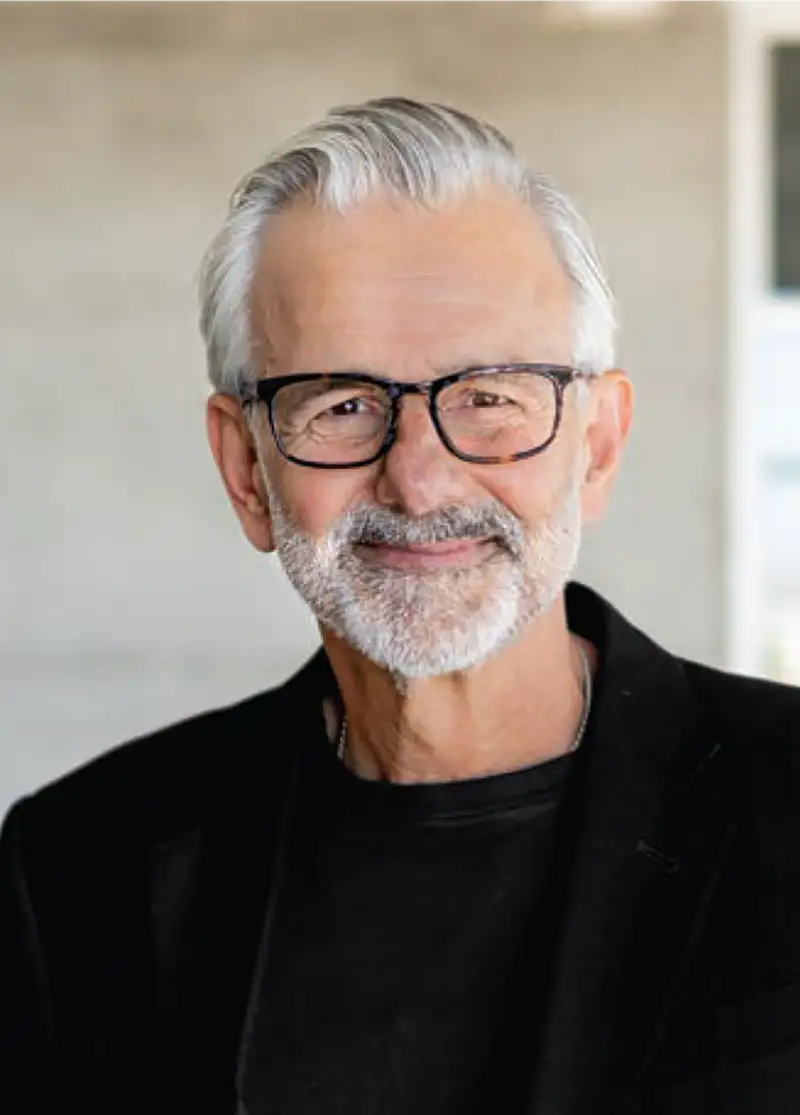
Mark Woodbury
From a Drafting Table to an Epic Universe: The Architectural Journey of Mark Woodbury
Mark Woodbury’s initial career aspiration was to become an astronaut, but it was a drafting class that eventually took him to where he is today—leading Universal Destinations & Experiences and the teams who create immersive worlds and attractions that showcase creativity and technology.
“My first choice was astronaut, but I think architecture was just before that in the dictionary,” said Woodbury. “When I really discovered architecture was when I took a drafting class. I was fortunate to have vocational classes in school growing up on Long Island. I got attached to holding a pencil. I thought that being able to visualize technical things was interesting to me at a young age.”
While he may not have become an astronaut, those initial influences, most notably the drafting class, have taken Woodbury on a journey as Chairman and CEO of Universal Destinations & Experiences, a unit of Comcast NBCUniversal that delivers some of the most innovative and sought-after entertainment experiences to audiences worldwide.
The Journey to Universal
Woodbury’s interest in the field blossomed as a middle schooler when his family moved from Long Island to the Chicago area, where he became fascinated by the big city and the famous architect and designer Frank Lloyd Wright.
“I think the big cities made a big impression on me. So, at a pretty young age, I would say probably sixth, seventh grade or so, I knew that’s where I was headed,” said Woodbury. “I had no idea what it meant, but I knew that’s what I was going to do.”
His direction in life was further shaped when he worked at a gas station in high school and became interested in the environment.
“I’ve been working since I was very young,” Woodbury said. “I worked at a gas station during the oil crisis of the mid- to late-seventies. And at that time, I realized the environment was a really important part of our lives. I was interested in what was referred to as ecology at the time. And then I experienced firsthand what an environmental crisis, like an oil crisis, would mean. So, I became very interested in the environment.”
Coming from the suburbs of Chicago to Albuquerque, Woodbury grew up in a big family and didn’t have the opportunity to travel on vacations to see other parts of the United States, which he sees as kind of ironic, given that he now leads Universal Destinations & Experiences.
New Mexico’s topography was one of the elements that factored into Woodbury’s decision to come to the Southwest. He was drawn to Albuquerque and The University of New Mexico after the oil crisis, and the School of Architecture was noted for its environmental design program, so UNM naturally rose to the top of Woodbury’s list.
“I didn’t really have much worldly exposure to other places. Arriving in Albuquerque and seeing the mountains and the mesa and the architecture, I mean, it was just a whole new world for me,” said Woodbury. “That, environmentally, as a place, opened my eyes to a bigger worldview, and that’s kind of what drew me to Albuquerque.
“New Mexico had a strong environmental design program, and that’s really what got me there, thinking about solar energy and passive design and all those things that the school was pretty well known for,” he added.
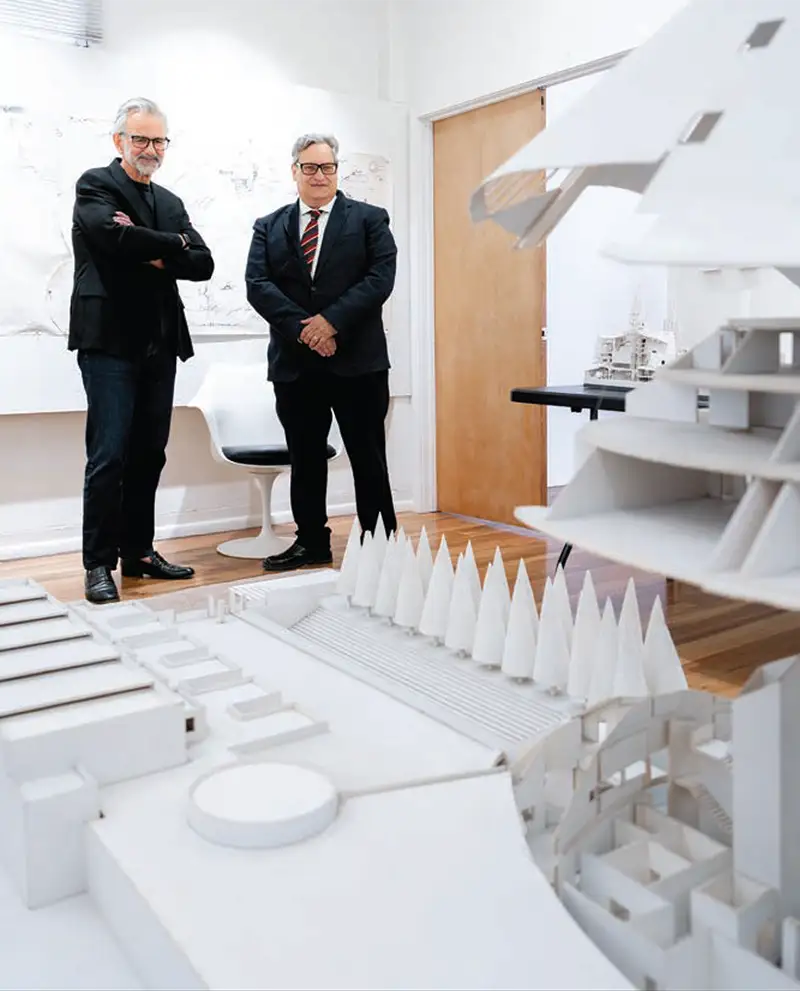
Chairman and Chief Executive Officer of Universal Destinations & Experiences Mark Woodbury and UNM School of Architecture + Planning Dean Robert Gonzalez discuss an architectural model during a recent UNM tour.
The UNM School of Architecture
UNM’s architecture program was very well rounded, with an emphasis on design and the creative process, an influence that continues to shape Woodbury today.
“Even with detailed solutions, it was really about the whole being greater than the sum of its parts,” Woodbury said. “It was about solving for a much bigger, complex set of issues.”
Woodbury noted some key themes that emerged: “What do we want people to experience through our work? What do we want them to take away from the connection to the work we were doing? I thought it was really important. And that stuck with me for a long time.”
He recalled Ed Norris, who ran UNM Design, Planning Assistance Center, commonly known as DPAC, who he worked with on the design of a classroom at the Navajo Elementary school, as well as a list of others who impacted his education.
“I spent a summer there in DPAC, and it was one of the most influential summers of my life working on a schoolhouse through that program,” recalled Woodbury. “It was really pretty amazing. I also learned a lot from Ann Taylor, who was very instrumental.”
“And believe it or not, it’s multiple decades later,” Woodbury laughs, “I can recite for you, and if I were a good artist, I could draw you the faces of people like David Kal and Howard Kaplan, Edith Cherry, Don Schlegel, Baker Morrow, Steve Dent and Wolfgang Pfizer. I can do that off the top of my head because that’s how important those personalities were and how formative those personalities were to me at a very sponge-like phase of my life.”
His early academic career helped shape much of how he thinks about the world, and was developed by the challenges he was presented with, which were unusual and unique in New Mexico. One of the first projects Woodbury worked on as an architecture student at UNM involved a team of players, which turned out to be a very memorable experience with the people he interacted with, who are still friends today.
“The power of that collaboration and its importance at an early phase of my academic career were really formative in becoming successful as an architect and as an executive,” said Woodbury. “We had a really wide variety of exercises in architecture school, and I think that mindset applied to anything we’re doing, whether that was designing a landscape or a building, or a piece of furniture.”
Speaking of furniture, he recalled an example that has stuck with him for decades when he was tasked to design a chair that was more than a chair, made out of cardboard.
“I remember thinking about that exercise,” he said. “I do remember clearly what my mindset at the time was: What in God’s name does that mean? You really had to kind of take a step back and think, how do I tackle this challenge and come up with something that is unique and different, and really push yourself to think outside traditional boundaries.”
That thinking continues to define his career even today.
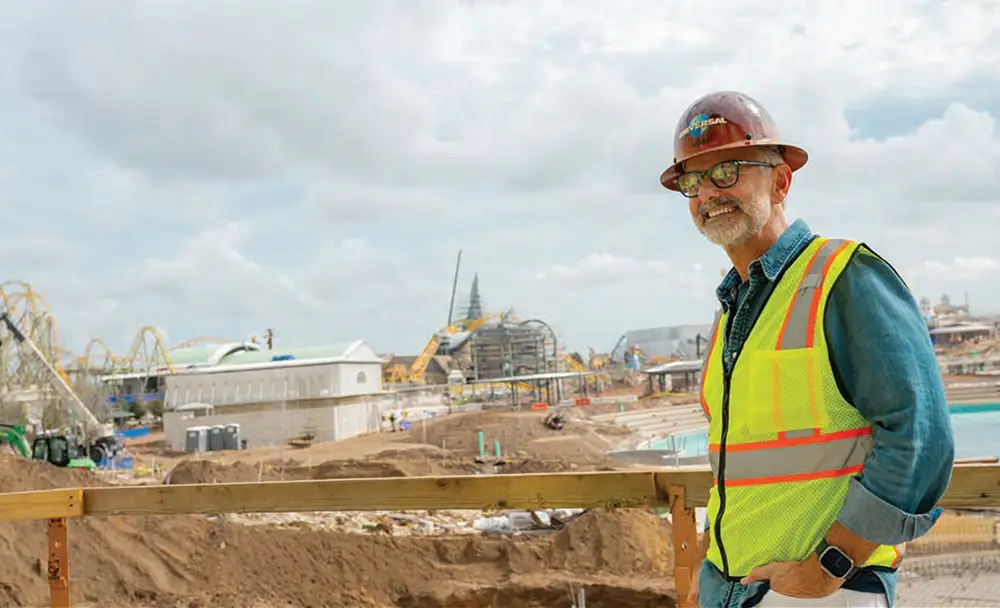
Mark Woodbury tours the site of Universal Epic Universe during the construction of the transformative park. Photo courtesy of Universal Destinations & Experiences.
“How is this attraction, land or world going to impact the people who experience it? What are they going to take away from that, from an experience standpoint, from creating a memory that lasts forever? In our case, we like to think about how we use those experiences or those designs to create an experience that’s truly memorable.”
After he graduated from UNM with a Bachelor of Arts in Architecture, another influential UNM professor, Stephen Dent, suggested he continue his education and pursue graduate school at the University of Wisconsin, where he earned his Master of Arts in Architecture. Once out of graduate school, he went into a traditional architectural practice. It was a direct application of his academic career to practice.
Universal Destinations & Experiences
Woodbury’s architectural training at UNM prepared him well for his entire career. He spent five years in traditional architecture before taking a risk and joining Universal.
“I took a risk and took that fork in the road and went into this business,” said Woodbury. “It started with master planning and architecture at a different scale. But then it developed into storytelling using technology and attractions, which ultimately led to a leadership role in the company as Chairman and CEO.”
Before that, Woodbury, who’s been with the company for more than 35 years, served as Vice Chair and President of Universal Creative, the division responsible for developing strategy and creating, planning, and designing all Universal attractions and destinations worldwide. He joined the company during the development of Universal Studios Florida and served on the creative leadership team. He is also a member of the NBCUniversal Executive Committee.
The phrase “how is this going to impact the people who experience it” has been prevalent throughout Woodbury’s career at Universal, leading teams that have blended architecture, engineering, storytelling, and technology. Despite the differences in scale and typology, the fundamentals are basically the same as in traditional architectural design.
The company’s latest theme park, the first major theme park to open in the United States in more than 25 years, is called Universal Epic Universe, featuring five themed worlds including Celestial Park, Dark Universe, and How to Train Your Dragon: Isle of Berk, in addition to The Wizarding World of Harry Potter’s Ministry of Magic and Super Nintendo World. Overall, the park contains some 50 attractions, including 30 dining and 21 retail locations.
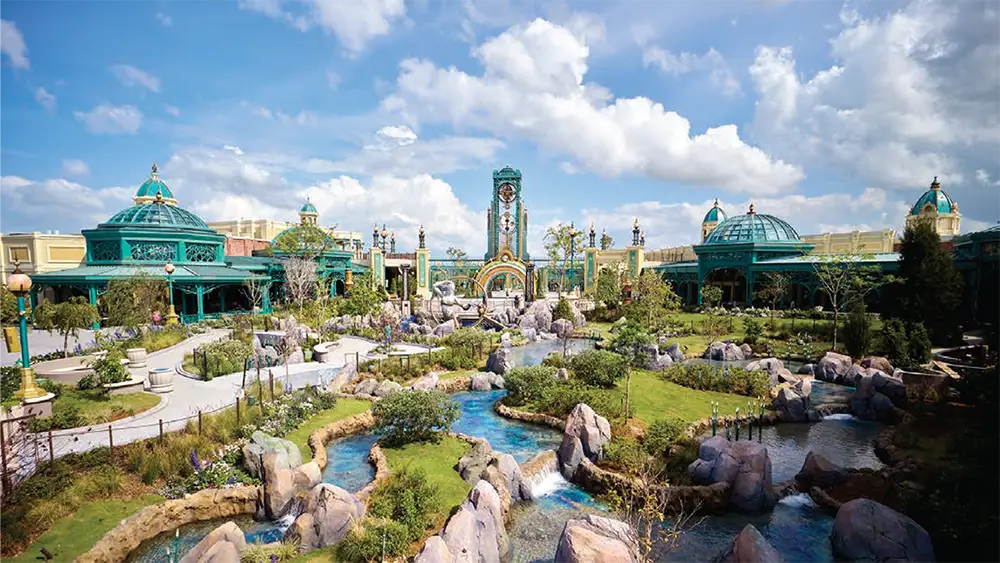
Celestial Park is the central hub of Universal Epic Universe, Universal Orlando’s new theme park. Elegant gardens and grand architecture create a breathtaking gateway to adventure. Photo courtesy of Universal Destinations & Experiences.
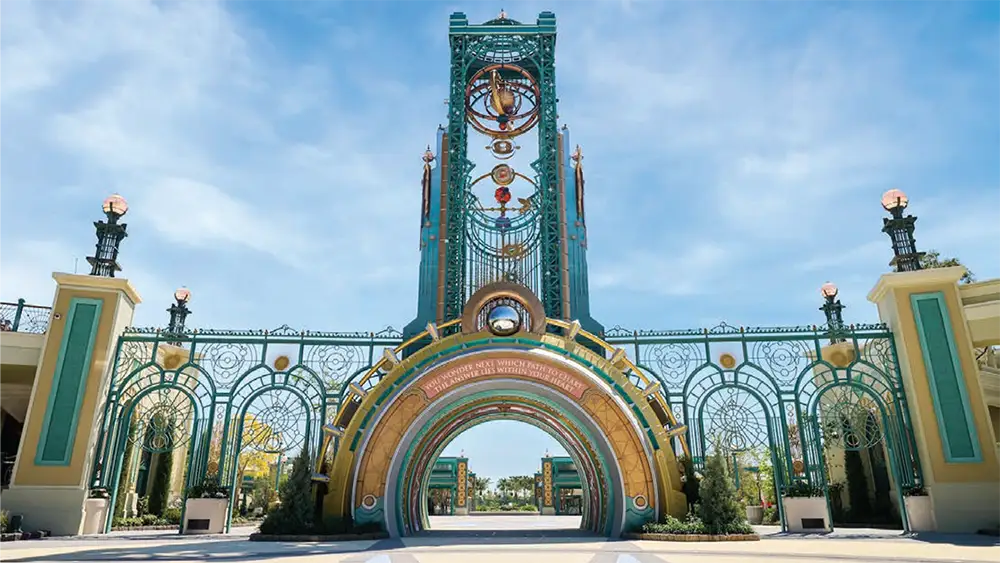
The Chronos at the main entrance of Universal Epic Universe welcomes guests inside Celestial Park. Photo courtesy of Universal Destinations & Experiences.
Epic is the fourth theme park at Universal Orlando Resort, and the idea of it started with a simple question: How could Universal Orlando become a weeklong destination for guests?
What the company found was that guests loved Universal’s immersive storytelling, thrilling rides, and entertainment. That insight set the challenge, and Universal officially announced its intent to build Epic in 2019.
“When you look at Harry Potter in our parks, it brings the places that people aspire to be a part of from those particular canons to life,” said Woodbury. “In the case of Super Nintendo World, how do you put people into the middle of a video game? Those are the different kinds of story-based and architectural challenges we face, many of which are non-traditional from an architectural point of view. The difference between parks and movies is we have to create a full 360-degree experience that lasts for decades.”
Woodbury’s background, along with the combination of creativity and technology, and how they’ve been applied to different aspects within his various roles throughout his career with Universal, have been instrumental. The fundamentals of his architectural education prepared him by helping to emphasize collaboration and instilling a sense of curiosity that has served him well over the years.
“Everything we do here is really a fusion of creativity and technology. It’s really that fusion of creativity, storytelling, and technology. That technology often delivers the visceral component, supported by sophisticated systems ranging from robotics to motion-based ride and show technologies.”
Woodbury’s teams have also navigated the complexities of developing global destinations, including Universal Beijing Resort and Universal Studios Japan, where architectural fundamentals—thoughtful design, placemaking, and narrative clarity—ensure that each destination feels authentic to its setting while delivering an unforgettable guest experience.
“The pillars of our business are to create mind-blowing experiences and deliver that with really breakthrough marketing and combine that with world-class guest service,” he said.
“Wherever we take that, we like to say that it’s universal, regardless of the geography. There are clearly cultural nuances to that, but the fundamentals of creating great stories and great experiences from a placemaking and architectural standpoint are pretty universal, no pun intended.”
A cornerstone of delivering exceptional guest experiences is the seamless collaboration among architecture, engineering, storytelling and technology—an approach that mirrors the deep collaborative nature of both architectural practice and the entertainment industry. Success in these complex, immersive environments depends on multidisciplinary teams working in concert, blending creative vision with technical precision to bring ambitious ideas to life.
“This work we do is heavily reliant upon a culture of collaboration,” said Woodbury. “Architects are really oftentimes the composer and the conductor of the orchestra, bringing together diverse expertise to create a cohesive end product. Our business is very much like that.”
Campus Connections
Latest
UNM Receives Renewal of Carnegie Elective Classification for Community Engagement
The University of New Mexico’s commitment to serving communities across the state continues to gain national recognition—something Lobo alumni know well through the University’s lasting impact.






Spring 2026 Mirage Magazine Features
Lobo Alliance Launches New Era for UNM Athletics
On March 4, Ryan Berryman was appointed Vice President and Director of Athletics. A three-time UNM...
Read More
From the Roof to the Field
Isabel Gonzalez covering the 2025 NCAA Women’s Basketball Final Four in Tampa Bay, Fla. From the...
Read More
Keeping Traditions Alive: Mayordomo Earns Degree, Inspires Rural Students
Vicente Fernandez, center, is the mayordomo of the Acequia Madre del Sur de Cañon del Don Fernando...
Read More
A World of Opportunity Close to Home
The Rainosek family with Jeff Todd, president and CEO of the UNM Foundation. A World of...
Read More
In Heels, She Climbed
Aprilyn Chavez Geissler is an executive leader at Gateway Insurance and Financial Services. In...
Read More
UNM and The Mother Road
The Kimo Theatre and Public Service Company of New Mexico on Route 66. Photo courtesy UNM CSWR....
Read More