Lobo Alliance Launches New Era for UNM Athletics
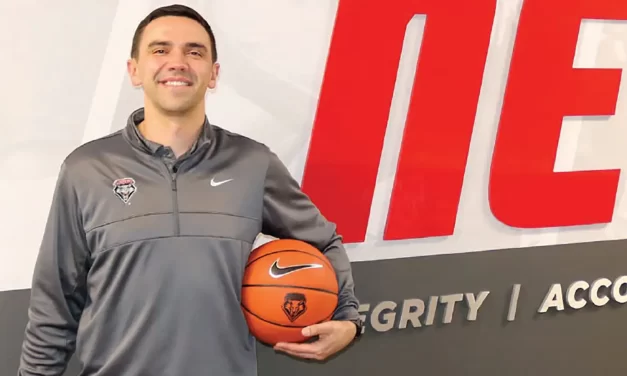
On March 4, Ryan Berryman was appointed Vice President and Director of Athletics. A three-time UNM...
Read More
The Kimo Theatre and Public Service Company of New Mexico on Route 66. Photo courtesy UNM CSWR.
Professor Emeritus David Dunaway
By Mary Beth King
Before there was a Route 66, The University of New Mexico was already an established college, sitting high on a hill above Albuquerque. At the time, the whole university was contained in one building, Hodgin Hall—administration, faculty and staff offices, library, labs, and classrooms. It wasn’t until 1926 that Route 66 was established, linking Chicago to Santa Monica and passing through New Mexico along the way.
“Route 66 passes right in front of the University, making us the largest university on Route 66,” said UNM Professor Emeritus of English David Dunaway. Dunaway is an authority on Route 66, producer of Across the Tracks; A Route 66 Story, and editor of A Route 66 Companion, an anthology of history and literature with pieces by authors such as Sylvia Plath, Thomas Wolfe, Ross McDonald, and Raymond Chandler.
Dunaway recently wrote an oral history of Route 66, co-authored by Associate Professor Stephen Benz of the UNM English department. But he wasn’t always as aware of the legendary Mother Road. For years, Dunaway never gave a second thought about Route 66.
“For me, Route 66 was just a street where I went to get a cup of coffee, where I went to the gym. It wasn’t Route 66 in capital letters. I didn’t visit Route 66. I just worked there. It wasn’t the destination that people from all over the world hope they can someday, on their bucket list, make it to Albuquerque and a hundred other cities and towns on the world’s most famous road.”
When Dunaway learned that Central Avenue was Route 66, an 18-mile swath through Albuquerque and past the UNM campus, he saw a new perspective.
“That exposes a fundamental tension between the Route 66 of the traveler and the tourist, and the Route 66 of the resident for whom the road may be just a way to the post office… It’s the road we live on and work on.”
Following that realization about 30 years ago, he began to dig into the history and culture of Route 66 and produced for National Public Radio (NPR) a three-hour documentary on Route 66 and pieces for the popular radio program All Things Considered.
The series has since been remastered and will air nationally to mark the Mother Road’s centennial on July 4 and again on Nov. 11, the anniversary of the official opening of the road. Dunaway explained how Route 66 came to be located adjacent to the UNM campus.
“More than 100 years ago, there was a path that went from Tijeras to the other side of Albuquerque and headed west toward Mount Taylor. It was natural that it would go past the University of New Mexico and pass through the center of the city, back when we were a town with wool wagons making their way through downtown. So, Route 66 and the university have always been entwined.”
There are other universities along Route 66, he noted, “but none of them have the population or prestige of the University of New Mexico.”
“At one point, the University, such as it was in the 1920s, would actually have had horses, maybe drawing drag lines to set up this major road to build it from a trail, a dirt road, then a graded road, and then a paved road in 1938.”
But unlike other roads that cross the country, Route 66 became much more than a paved road, but rather a cultural icon, immortalized in music, literature, and broadcast media, drawing visitors from all over the world to immerse themselves in the romance.

Photo courtesy UNM CSWR.
From Albuquerque, Route 66 headed north through Bernalillo and towards Santa Fe and Las Vegas. Photo courtesy UNM CSWR.
“Everybody knows the story of how the Dust Bowl in Oklahoma and Texas created an exodus from that part of the American Southwest, and most people went west to California, to the land of opportunity and, as Jimmy Rodgers sang in ‘Blue Yodel No. 4 (California Blues),’ ‘I’m going to California where they sleep out every night…’”
After the war, Dunaway explained, there was a burst of travel along the old road with returning soldiers who, with their families, wanted to take a vacation.
“Route 66 was the all-weather road from the beginning. That’s the way it was designed. Route 10 on the border was too hot. The Lincoln Highway to the north was too snowy. Route 66 was a road you could drive at all times, so people began taking this trip, and it was a very exotic one. It took people to Native American tribes they’d never seen. It was full of oddities and strange items, and people came back. Into the ’50s, with this notion that here was an unusual experience.”
Then popular singer Nat King Cole and his trio recorded a song in 1946.
“If you ever plan to motor west
Travel my way, take the highway that’s the best
Get your kicks on Route 66
It winds from Chicago to LA
More than two thousand miles all the way
Get your kicks on Route 66…”
“That stirred things up even more, and from 1959 to 1963, we actually had a television series called Route 66 about a pair of young guys traveling around in a fast Corvette with no particular destination,” Dunaway said, noting that the show is still popular and running in syndication around the world.
“The combination of a road which tickled people’s fancy, which had its own theme song, which had its own TV series, all of these added up to an evocation of what Route 66 came to mean to America and to the world. The chance to drive for Europeans 2,000 miles without hitting a single border, without hitting a single checkpoint. The chance to travel out of the two great cities at either end, into really rural areas, into deep forests near Flagstaff and the Continental Divide, into small-town life. All these together, merged into a sense of American adventure, and that’s what makes Route 66 arguably the most famous road in the world.”

Postcard, El Rancho, Gallup, NM, on Route 66, by M.W.M., Aurora, MO, from Postcard Coll., CSWR
Dunaway would like to see UNM take more advantage of its proximity to the historic cultural icon and has been trying to organize a national center for the study of Route 66 on campus for about 20 years. Plans were for an effort that would draw people from across the University, from real estate, from finance, from various departments who were teaching or doing research on Route 66. Space was allotted at the corner of University Avenue and Central Avenue.

The Kimo Theatre and Public Service Company of New Mexico on Route 66. Photo courtesy UNM CSWR.
Historic Route 66, Across the Rio Grande, Los Lunas, N.M. Photo courtesy UNM CSWR.
UNM’s new Center for Collaborative Arts & Technology is being built on Route 66. Its location along Central Avenue, it is hoped, will animate the street, create new vibrancy, and showcase the talents of the UNM College of Fine Arts to the public.
“Just as UNM’s connection to Route 66 has long inspired new beginnings through exploration, CCAT represents what can be achieved through collaboration and innovation,” said College of Fine Arts Dean Harris Smith.
Dunaway acknowledges there is some ugliness in the history of the road too: “I want to rebalance Route 66, to consider the communities that willingly and unwillingly gave up their land for the railroad to come through, and later Route 66. The Native and Hispanic communities. It’s also a road that was difficult for African Americans to travel. They needed the Green Book to get them to places. So, my Route 66 is a broad avenue into American history, which opens up many of its unresolved issues. I want Route 66 to be seen as a road for all and with a place for all.”
“Although it’s an American road, it belongs to the world. There are Route 66 societies in Switzerland, Brazil, Japan, Germany. We have offered the world an ideal. Of small-town living, big city life, and vast spaces in between. And they come by the thousands to visit. It’s time that Albuquerque and the University step up and recognize the incredible potential… I’m hopeful that will come about as a result of interest this year in the Mother Road, as John Steinbeck called it.”
Beyond Route 66, Dunaway’s scholarship spans other cultural histories. His latest book is A Four-eyed World: How Glasses Changed the Way We See, a historical and humorous look at how eyeglasses shaped culture, science and the way we see today and quotes well-known people from Shakespeare to James Bond to Marilyn Monroe on the subject of glasses.
On March 4, Ryan Berryman was appointed Vice President and Director of Athletics. A three-time UNM...
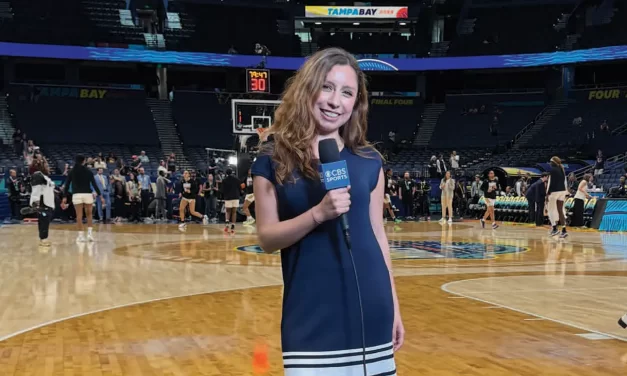
Read MoreIsabel Gonzalez covering the 2025 NCAA Women’s Basketball Final Four in Tampa Bay, Fla. From the...
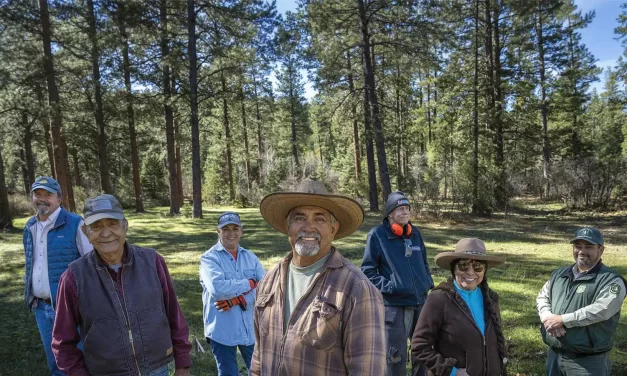
Read MoreVicente Fernandez, center, is the mayordomo of the Acequia Madre del Sur de Cañon del Don Fernando...
Read MoreThe Rainosek family with Jeff Todd, president and CEO of the UNM Foundation. A World of...
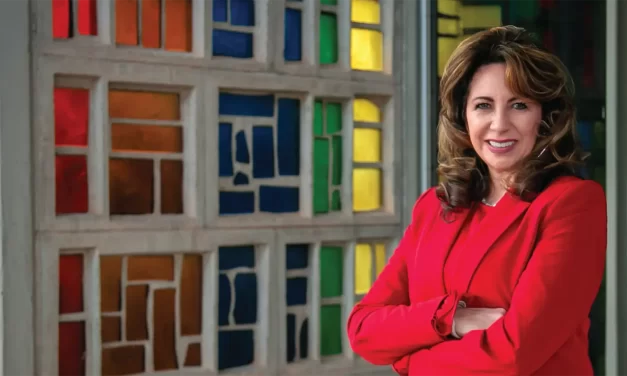
Read MoreAprilyn Chavez Geissler is an executive leader at Gateway Insurance and Financial Services. In...
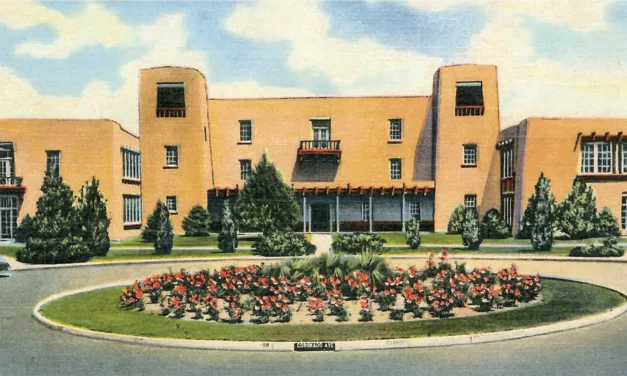
Read MoreThe Kimo Theatre and Public Service Company of New Mexico on Route 66. Photo courtesy UNM CSWR....
Read More
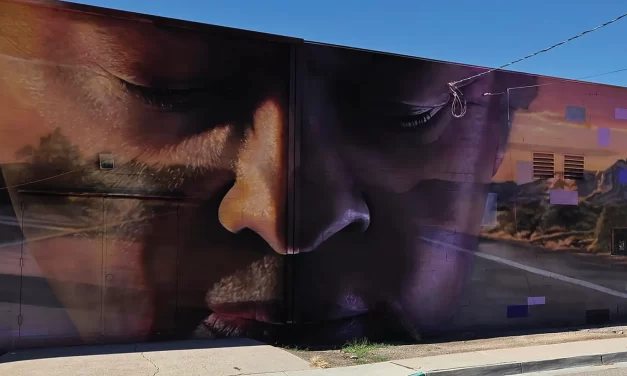
The citywide project reimagines Albuquerque’s stretch of the legendary highway through a collection of murals, sculptures, and cutting-edge augmented reality (AR) experiences, blending history, art, and innovation into an immersive celebration of culture. The series honors the road’s history and legacy while drawing new attention to preservation and revitalization efforts along the corridor. The purpose of the projects is to celebrate the anniversary of the historic road’s establishment and bring new awareness to efforts to preserve, maintain, restore, and return to use historic properties along the Route 66 corridor.
The UNM mural was created in collaboration with former UNM art student Travis Black.
Like the Mother Road Barnett is celebrating with this latest work, the road to his diploma at UNM was a long one. A native of Albuquerque, Barnett graduated from Volcano Vista High School before enrolling at UNM as an Architecture major.
He soon switched to Criminology, then Accounting, before stepping away from school altogether. After a brief stint as a service aide with the Albuquerque Police Department, he reassessed.
“I didn’t feel like it was necessary to get a degree in the career field that I was pursuing so I stopped going to college but then when the career field I was pursuing didn’t pan out, I decided to go back and declared Fine Arts as my major with a focus on painting and drawing.”
He graduated in 2018 with a Bachelor of Fine Arts degree in Art Studio.
Among the faculty members who shaped his development was UNM art instructor Beau Carey, also a UNM alumnus and Albuquerque-based painter.
“Beau Carey was pivotal in my journey,” Barnett recalled. “UNM just gave me the space and the capacity to paint, just being so new and fresh to the art world and not really having the artistic skills, the knowledge, about really how to do anything. It gave me the space and the ability to really hone in on my craft and set me on the path.”
Barnett’s work is a familiar sight around town to local residents.
Among his murals are Mountain Top at the intersection of Tijeras and 1st Street in downtown Albuquerque, which honors the legacy of Martin Luther King Jr. and also includes images of Booker T. Washington, Coretta Scott King, and Frederick Douglass. A giant roadrunner streaks down Eighth Street downtown. A Native American artist plies his craft on the side of the Turquoise Museum on Second Street, S.W.
Noé Barnett at the press conference that featured the unveiling of the Route 66 Remixed mural ‘Mother: Moment,’ one of 16 art installations across the city.
“They explained what the project was, discussed the scope, brought up the centennial and then just paired up myself and Travis together. We never met, so there was a familiarization process of us getting to know one another. They gave us a timeline and told us that we wanted to have this done by the end of September.”
Inspiration for the project came through researching the highway’s history.
“I don’t think being from New Mexico you automatically have a sense of its importance. My parents being from the Midwest and driving on road trips over the summer familiarized me with the road. A lot of the nostalgia, even the memorabilia you see, on postcards and then all throughout the country really helped me research and understand what it was.”
Barnett noted that Route 66 is called the Mother Road, “so I used that as the anchor for the mural, which is why I decided to include my mom Michelle as the focal point and the design is centered on that and everything expands from there. It’s almost as if it’s a memory of past experiences on road trips and traveling on the road.”
Everything in the distinctive pixelated style called “voxels” was done by Black and Barnett painted everything else. The flowers in the design tie into his studio practice.
“It was an honor to be part of this and work with Noé and to work with the university and Meow Wolf and the city,” Black said. “It wasn’t quite like anything I’ve done before to kind of turn that corner every day and just see our progress and to see such a large production felt great.”
Black moved to Albuquerque in 2005 to attend UNM on an Amigo scholarship.
“I saw the quality of the professors and the affordable price and my then-girlfriend and now spouse decided to adventure out here from Michigan. I have always thought my college experience was something that helped me tremendously. I made important connections with students and teachers, and I grew a lot,” he said.
Black created the blocky Lego® or voxel images—the 3-D pixelated-looking designs, creatures, signs, and automobiles.
“Getting to know Noé and collaborating with him has been such a pleasure. Noé was so easy to work with, he knew what he wanted, but he also cared about my perspective, so I’d say it was a really rewarding and successful meeting of minds… Noé is an Olympian of his technique, well respected in the art and mural world at large and a great guy. I’m glad to be connected with him and my life is enhanced by his work and presence.”
“As students, both Noé Barnett and Travis Black exemplify the wealth of talent within the College of Fine Arts. I couldn’t think of a better way to celebrate the inspiring history of Route 66 than with this amazing mural, which captures what makes New Mexico truly the Land of Enchantment,” said College of Fine Arts Dean Harris Smith.
UNM’s new Center for Collaborative Arts & Technology is being built on Route 66 a couple blocks east of the Mother: Moment mural. Its location along Central Avenue will, it is hoped, animate the street and showcase the talents of the UNM College of Fine Arts to the public.
In addition to being a full-time muralist for over five years, Barnett paints in his home studio. His canvases feature bold, colorful floral imagery suffused with light.
“My studio work is all influenced by light both in the metaphysical and physical sense. Flowers and vegetation use light to feed themselves through photosynthesis and in turn give us back beauty so they essentially are solar powered and they feed themselves on the light. So right now, my studio practice is a focus on light in various capacities. I use light both as the subject and a medium with reflective layers and seeing things differently through different angles and through the different forms of light.”
Barnett’s work will be on display this summer at the Albuquerque Museum in Old Town and the Secret Gallery located in the Arrive Hotel downtown.
Led by the City of Albuquerque’s Department of Arts & Culture, Route 66 Remixed invites locals and visitors alike to explore the legacy of the Mother Road through a modern creative lens. With support from Visit Albuquerque, the New Mexico Tourism Department, community organizations, and property owners, the project transforms Central Avenue into a living art corridor—an art-fueled road trip showcasing the stories, traditions, and people that continue to shape Albuquerque’s identity.
Along the route, travelers will discover large-scale installations and site-specific digital features that reflect the stories, traditions, and people that have helped shape Albuquerque. Route 66 Remixed is created in partnership with Meow Wolf, Refract Studio, and local artists. The project includes 18 art attractions along Albuquerque’s 18-mile stretch of Route 66 that can be experienced on their own or explored together via a web interface. UNM law school grad Hakim Bellamy, Albuquerque’s inaugural poet laureate, is the road trip narrator and storyteller.

A wall of color at the studio of Noé Barnett highlights the vibrant colors noted in his artwork.
Art Along the Mother Road: UNM Alum Helps Lead Route 66 RemixedFeature, Spring 2026 A century...
Read MoreUniversal Epic Universe, which opened in May 2025, is Universal’s most ambitious project yet and...
Read MoreA new bridge was installed as part of the Duck Pond renovation. Renewing a Lobo Tradition:...
Read More
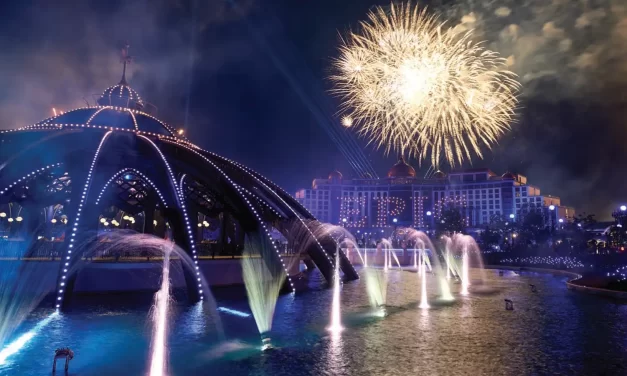
Universal Epic Universe, which opened in May 2025, is Universal’s most ambitious project yet and marked the first major theme park built in the U.S. in 25 years. Photo courtesy of Universal Destinations & Experiences.
Mark Woodbury
Mark Woodbury’s initial career aspiration was to become an astronaut, but it was a drafting class that eventually took him to where he is today—leading Universal Destinations & Experiences and the teams who create immersive worlds and attractions that showcase creativity and technology.
“My first choice was astronaut, but I think architecture was just before that in the dictionary,” said Woodbury. “When I really discovered architecture was when I took a drafting class. I was fortunate to have vocational classes in school growing up on Long Island. I got attached to holding a pencil. I thought that being able to visualize technical things was interesting to me at a young age.”
While he may not have become an astronaut, those initial influences, most notably the drafting class, have taken Woodbury on a journey as Chairman and CEO of Universal Destinations & Experiences, a unit of Comcast NBCUniversal that delivers some of the most innovative and sought-after entertainment experiences to audiences worldwide.
Woodbury’s interest in the field blossomed as a middle schooler when his family moved from Long Island to the Chicago area, where he became fascinated by the big city and the famous architect and designer Frank Lloyd Wright.
“I think the big cities made a big impression on me. So, at a pretty young age, I would say probably sixth, seventh grade or so, I knew that’s where I was headed,” said Woodbury. “I had no idea what it meant, but I knew that’s what I was going to do.”
His direction in life was further shaped when he worked at a gas station in high school and became interested in the environment.
“I’ve been working since I was very young,” Woodbury said. “I worked at a gas station during the oil crisis of the mid- to late-seventies. And at that time, I realized the environment was a really important part of our lives. I was interested in what was referred to as ecology at the time. And then I experienced firsthand what an environmental crisis, like an oil crisis, would mean. So, I became very interested in the environment.”
Coming from the suburbs of Chicago to Albuquerque, Woodbury grew up in a big family and didn’t have the opportunity to travel on vacations to see other parts of the United States, which he sees as kind of ironic, given that he now leads Universal Destinations & Experiences.
New Mexico’s topography was one of the elements that factored into Woodbury’s decision to come to the Southwest. He was drawn to Albuquerque and The University of New Mexico after the oil crisis, and the School of Architecture was noted for its environmental design program, so UNM naturally rose to the top of Woodbury’s list.
“I didn’t really have much worldly exposure to other places. Arriving in Albuquerque and seeing the mountains and the mesa and the architecture, I mean, it was just a whole new world for me,” said Woodbury. “That, environmentally, as a place, opened my eyes to a bigger worldview, and that’s kind of what drew me to Albuquerque.
“New Mexico had a strong environmental design program, and that’s really what got me there, thinking about solar energy and passive design and all those things that the school was pretty well known for,” he added.
Chairman and Chief Executive Officer of Universal Destinations & Experiences Mark Woodbury and UNM School of Architecture + Planning Dean Robert Gonzalez discuss an architectural model during a recent UNM tour.
UNM’s architecture program was very well rounded, with an emphasis on design and the creative process, an influence that continues to shape Woodbury today.
“Even with detailed solutions, it was really about the whole being greater than the sum of its parts,” Woodbury said. “It was about solving for a much bigger, complex set of issues.”
Woodbury noted some key themes that emerged: “What do we want people to experience through our work? What do we want them to take away from the connection to the work we were doing? I thought it was really important. And that stuck with me for a long time.”
He recalled Ed Norris, who ran UNM Design, Planning Assistance Center, commonly known as DPAC, who he worked with on the design of a classroom at the Navajo Elementary school, as well as a list of others who impacted his education.
“I spent a summer there in DPAC, and it was one of the most influential summers of my life working on a schoolhouse through that program,” recalled Woodbury. “It was really pretty amazing. I also learned a lot from Ann Taylor, who was very instrumental.”
“And believe it or not, it’s multiple decades later,” Woodbury laughs, “I can recite for you, and if I were a good artist, I could draw you the faces of people like David Kal and Howard Kaplan, Edith Cherry, Don Schlegel, Baker Morrow, Steve Dent and Wolfgang Pfizer. I can do that off the top of my head because that’s how important those personalities were and how formative those personalities were to me at a very sponge-like phase of my life.”
His early academic career helped shape much of how he thinks about the world, and was developed by the challenges he was presented with, which were unusual and unique in New Mexico. One of the first projects Woodbury worked on as an architecture student at UNM involved a team of players, which turned out to be a very memorable experience with the people he interacted with, who are still friends today.
“The power of that collaboration and its importance at an early phase of my academic career were really formative in becoming successful as an architect and as an executive,” said Woodbury. “We had a really wide variety of exercises in architecture school, and I think that mindset applied to anything we’re doing, whether that was designing a landscape or a building, or a piece of furniture.”
Speaking of furniture, he recalled an example that has stuck with him for decades when he was tasked to design a chair that was more than a chair, made out of cardboard.
“I remember thinking about that exercise,” he said. “I do remember clearly what my mindset at the time was: What in God’s name does that mean? You really had to kind of take a step back and think, how do I tackle this challenge and come up with something that is unique and different, and really push yourself to think outside traditional boundaries.”
That thinking continues to define his career even today.

“How is this attraction, land or world going to impact the people who experience it? What are they going to take away from that, from an experience standpoint, from creating a memory that lasts forever? In our case, we like to think about how we use those experiences or those designs to create an experience that’s truly memorable.”
After he graduated from UNM with a Bachelor of Arts in Architecture, another influential UNM professor, Stephen Dent, suggested he continue his education and pursue graduate school at the University of Wisconsin, where he earned his Master of Arts in Architecture. Once out of graduate school, he went into a traditional architectural practice. It was a direct application of his academic career to practice.
Woodbury’s architectural training at UNM prepared him well for his entire career. He spent five years in traditional architecture before taking a risk and joining Universal.
“I took a risk and took that fork in the road and went into this business,” said Woodbury. “It started with master planning and architecture at a different scale. But then it developed into storytelling using technology and attractions, which ultimately led to a leadership role in the company as Chairman and CEO.”
Before that, Woodbury, who’s been with the company for more than 35 years, served as Vice Chair and President of Universal Creative, the division responsible for developing strategy and creating, planning, and designing all Universal attractions and destinations worldwide. He joined the company during the development of Universal Studios Florida and served on the creative leadership team. He is also a member of the NBCUniversal Executive Committee.
The phrase “how is this going to impact the people who experience it” has been prevalent throughout Woodbury’s career at Universal, leading teams that have blended architecture, engineering, storytelling, and technology. Despite the differences in scale and typology, the fundamentals are basically the same as in traditional architectural design.
The company’s latest theme park, the first major theme park to open in the United States in more than 25 years, is called Universal Epic Universe, featuring five themed worlds including Celestial Park, Dark Universe, and How to Train Your Dragon: Isle of Berk, in addition to The Wizarding World of Harry Potter’s Ministry of Magic and Super Nintendo World. Overall, the park contains some 50 attractions, including 30 dining and 21 retail locations.

Celestial Park is the central hub of Universal Epic Universe, Universal Orlando’s new theme park. Elegant gardens and grand architecture create a breathtaking gateway to adventure. Photo courtesy of Universal Destinations & Experiences.

The Chronos at the main entrance of Universal Epic Universe welcomes guests inside Celestial Park. Photo courtesy of Universal Destinations & Experiences.
Epic is the fourth theme park at Universal Orlando Resort, and the idea of it started with a simple question: How could Universal Orlando become a weeklong destination for guests?
What the company found was that guests loved Universal’s immersive storytelling, thrilling rides, and entertainment. That insight set the challenge, and Universal officially announced its intent to build Epic in 2019.
“When you look at Harry Potter in our parks, it brings the places that people aspire to be a part of from those particular canons to life,” said Woodbury. “In the case of Super Nintendo World, how do you put people into the middle of a video game? Those are the different kinds of story-based and architectural challenges we face, many of which are non-traditional from an architectural point of view. The difference between parks and movies is we have to create a full 360-degree experience that lasts for decades.”
Woodbury’s background, along with the combination of creativity and technology, and how they’ve been applied to different aspects within his various roles throughout his career with Universal, have been instrumental. The fundamentals of his architectural education prepared him by helping to emphasize collaboration and instilling a sense of curiosity that has served him well over the years.
“Everything we do here is really a fusion of creativity and technology. It’s really that fusion of creativity, storytelling, and technology. That technology often delivers the visceral component, supported by sophisticated systems ranging from robotics to motion-based ride and show technologies.”
Woodbury’s teams have also navigated the complexities of developing global destinations, including Universal Beijing Resort and Universal Studios Japan, where architectural fundamentals—thoughtful design, placemaking, and narrative clarity—ensure that each destination feels authentic to its setting while delivering an unforgettable guest experience.
“The pillars of our business are to create mind-blowing experiences and deliver that with really breakthrough marketing and combine that with world-class guest service,” he said.
“Wherever we take that, we like to say that it’s universal, regardless of the geography. There are clearly cultural nuances to that, but the fundamentals of creating great stories and great experiences from a placemaking and architectural standpoint are pretty universal, no pun intended.”
A cornerstone of delivering exceptional guest experiences is the seamless collaboration among architecture, engineering, storytelling and technology—an approach that mirrors the deep collaborative nature of both architectural practice and the entertainment industry. Success in these complex, immersive environments depends on multidisciplinary teams working in concert, blending creative vision with technical precision to bring ambitious ideas to life.
“This work we do is heavily reliant upon a culture of collaboration,” said Woodbury. “Architects are really oftentimes the composer and the conductor of the orchestra, bringing together diverse expertise to create a cohesive end product. Our business is very much like that.”
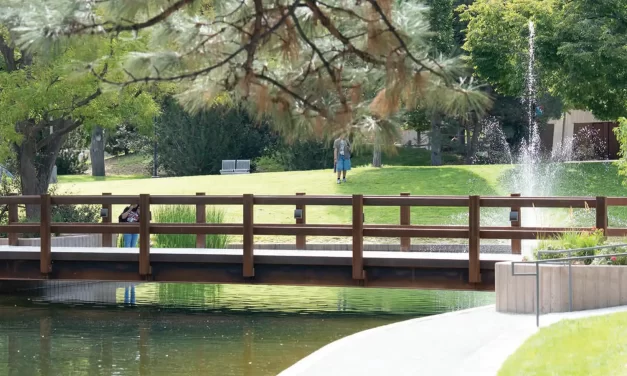
A new bridge was installed as part of the Duck Pond renovation.
Located at the heart of campus, the Duck Pond has long served as a backdrop for conversations between classes, quiet moments of study, and celebrations that mark life’s milestones. Since its creation in 1976, the pond has become one of UNM’s most recognizable and beloved landmarks—an enduring part of the Lobo experience that many alumni remember fondly.
After a comprehensive renovation designed to preserve its historic character while strengthening its sustainability and accessibility, the Duck Pond has officially reopened to the campus community.
“The Duck Pond is so much more than a pretty spot on campus. It is part of the heart of UNM,” said Executive Vice President for Finance and Administration Teresa Costantinidis. “It’s where students relax between classes, faculty and staff take a moment to connect with nature during the day, and families from across Albuquerque gather for graduation photos, quinceañeras and wedding celebrations. It’s where our neighbors walk their dogs each day and little kids learn to ride bikes. The variety of birds that call the pond home bring beauty, life, and a sense of calm to all who visit. Restoring it with such care feels like honoring all those joyful moments. UNM is proud to preserve this cherished place for everyone in our community. I am so happy to see it renewed and ready for the next generation of Lobos.”
The Duck Pond Revitalization Project addressed aging infrastructure while preserving the pond’s historic design. Originally created as a man-made urban water feature by renowned landscape architect Garrett Eckbo and completed in 1976, the pond has grown over nearly five decades into a defining feature of campus life for students, faculty, staff, alumni and the greater Albuquerque community.
“While the general nature and shape of the pond remains the same, the physical changes to the pond were reviewed by the UNM Historic Preservation Committee to recognize and preserve the original design intent by renowned campus architect Garrett Eckbo,” explained Facilities Services Project & Construction Manager Michael Pierce. “All of these changes and effort will result in a cleaner, safer, and more sustainable ecological environment for the wildlife and all users of this beloved campus landmark.”
“It is my privilege to help celebrate the reopening of this very special place—a place that over the last 50 years has come to be not just an iconic feature of our landscape, but also the very heart of our campus itself,” said UNM President Garnett S. Stokes. “This is a place where generations of Lobos have joyfully met with new friends, celebrated accomplishments loudly, or quietly studied in the shade. It’s a place where faculty and staff can take a moment to recharge and reflect at the end—or even the middle—of a long day.
“I don’t think it’s overstatement to say that the Duck Pond is UNM. It’s a beloved symbol of our university, one of the first locations visitors head for, and one of the most-photographed icons on our campus. With this renovation, we haven’t just restored a pond; we’ve renewed a piece of our shared history and invested in our future,” added Stokes.

A spectacular view of one of the fountains after the Duck Pond renovation.
The renovation focused on improving water quality, ecological health, accessibility and long-term maintenance while preserving the pond’s historic charm. Importantly, the Duck Pond’s iconic shape, appearance and waterfall remain unchanged.
Major upgrades include a new pond liner to prevent water loss, modern biofilters, and a UV treatment system that improves water quality by reducing harmful algae and microorganisms.
Accessibility improvements allow visitors—including those using mobility aids—to reach every edge of the pond, making the space more inclusive for the entire community.
Materials used in the planter walls and pond enclosure were upgraded for durability, while the pond’s mechanical systems were modernized to improve water circulation and ecological balance. These updates will reduce maintenance needs while helping preserve the pond’s natural beauty for years to come.
Pathways around the pond were widened in select areas and regraded to meet accessibility standards so that everyone can enjoy the space. Some trees in poor condition were removed for safety reasons, and new trees were planted to continue the pond’s tradition of shade and greenery.
The revitalization project also reflects the university’s broader commitment to sustainability and campus stewardship, aligning with goals outlined in UNM’s 2040 strategic vision.
“The restoration of this valuable Heritage Zone marks UNM’s investment in our campus character, community assets, and commitment to sustainability,” said University Planner and Director of Campus Capital and Space Planning Rosie Dudley. “It upholds the original vision and preservation guidelines while improving the water quality and habitat, making it easier to maintain, and improving safety and security with enhanced lighting and accessible paths.”
“Future phases of improvements will include further furniture and landscaping enhancements to make this space a destination for future Lobos and the community at-large, enabling the Duck Pond to continue to hold a special place in so many people’s hearts.”
Additionally, new benches designed to match the historic character of the space were installed in nine existing seating areas, and two additional seating areas will also be added near Mitchell Hall at the south end of the pond.
For alumni returning to campus—or simply remembering their time at UNM—the Duck Pond remains what it has always been: a place to pause, reconnect, and experience the spirit of the Lobo community.

UNM President Garnett S. Stokes cuts the ribbon officially re-opening the UNM Duck Pond.
The Duck Pond is completed as part of UNM’s Central Campus landscape design by renowned landscape architect Garrett Eckbo.
The Duck Pond becomes one of campus’s most photographed locations and a favorite gathering spot for students studying, socializing and relaxing between classes.
The Duck Pond grows into a community landmark, hosting graduation photos, campus events and visits from alumni returning to campus.
UNM begins a comprehensive revitalization project to modernize the pond’s infrastructure while preserving its historic design and character.
With improved water quality systems, enhanced accessibility and restored infrastructure, the Duck Pond continues its legacy as one of the heartbeats of the Lobo experience.
Each year I’m reminded how extraordinary the Lobo community truly is. Whether gathering on campus, cheering on the Pack across the country, mentoring students, or celebrating one another’s achievements, our alumni continue to show that being a Lobo is truly a lifelong connection.
From our popular green chile roasts to Lobo Living Rooms, Senior Send-Off celebrations, and regional chapter gatherings, thousands of Lobos connected with one another and with the University we all care so deeply about over the past year.
One of the highlights of the year was seeing Lobo pride on display across the country. Hundreds of alumni and fans joined us in Las Vegas for our signature Post Up at the Mountain West Basketball Championships. In the fall, alumni traveled to the Rose Bowl to watch Lobo football upset the Bruins, returned to Albuquerque for a sold-out Rio Grande Rivalry, and saw Coach Jason Eck lead the Lobos to the Rate Bowl.
Homecoming was another unforgettable moment. Last fall we celebrated UNM’s 100th Homecoming football game with a week of activities, from a Lobo Living Room basketball preview to our new ReUnite with the Pack gathering and a spirited tailgate before a victory over Nevada.
We also celebrated the future of our Lobo community, awarding 45 scholarships, including a new Seattle alumni chapter scholarship.
Our Lobo Living Room series showcased some of UNM’s most exciting programs, from the cultural impact of Taylor Swift and Les Misérables to an alumni tour of the new $842 million UNM Hospital Critical Care Tower.
We look forward to milestones this year including the opening of the Center for Collaborative Arts & Technology and the groundbreaking for the Humanities and Social Sciences Complex—both shaping UNM’s future for generations.
Another proud tradition is recognizing alumni who exemplify Lobo spirit. The UNM Alumni Awards Dinner celebrated outstanding graduates making an impact in their professions and communities, while the UNM Black Alumni Chapter honored leaders through its Trailblazers and Living Legends Awards.
Supporting students as they begin their careers remains core to our mission. At Senior Send-Off events, alumni volunteers provided career advice, résumé reviews, networking opportunities, and professional headshots—connections that can make all the difference.
Our regional alumni chapters continue to keep the Lobo spirit alive across the country, hosting game watches, alumni gatherings, and community events from Denver to San Diego to Phoenix and Washington, D.C.
One of our most beloved traditions, green chile roasts, continues to grow. In 2025, alumni and regional chapters roasted more than 13,000 pounds of chile at events around the country, including a packed celebration at Winrock Town Center Park here in Albuquerque.
The Green Chile Roasts program, along with Mirage Magazine, earned two Best of District IV Awards from the Council for Advancement and Support in Education. The awards recognize the outstanding work happening at UNM Alumni.
Today, the Lobo alumni community is more than 225,000 strong worldwide, and every one of you plays a role in shaping the future of our University. Thank you for supporting The University of New Mexico and keeping the Lobo spirit strong wherever you go.
Go Lobos!
Connie Beimer (’76 BA, ’79 MPA)
Vice President for Alumni Relations, UNM
Executive Director, UNM Alumni Association
FROM THE EXECUTIVE DIRECTOR, UNM ALUMNI ASSOCIATIONJul 13, 2026 | Alumni Executive Director...
Recent Comments